Impacted Wisdom Teeth: A Common Condition
9 Out of 10
Did you know that 9/10 patients have at least one impacted wisdom tooth? In fact, it’s the number one reason that we remove them!
32 Teeth, 28 Spaces
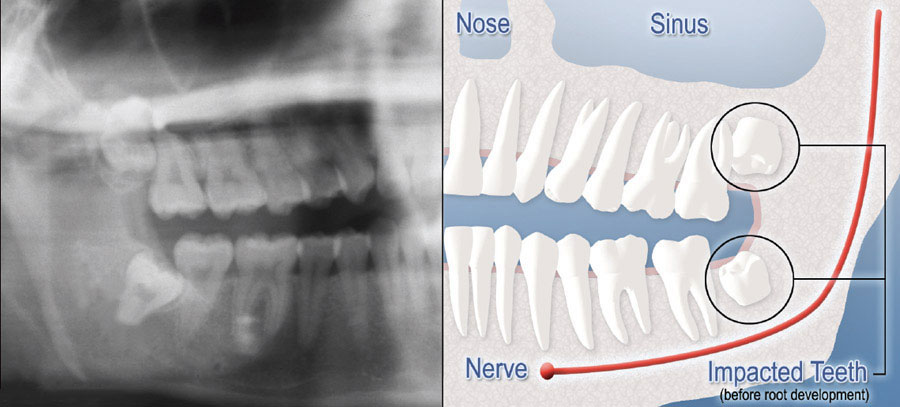
Our jaws have space for 28 teeth. That is enough room to accommodate the first and second, but not the third molars (another name for “wisdom teeth”). Because these are the last to show up, there often isn’t enough room for them to grow.
What does it mean if a tooth is impacted?
All of this crowding results in the wisdom teeth being unable to erupt through the gums properly – a condition commonly referred to as “impacted”. Often they grow in sideways, backward, tilted, and, sometimes, they may even remain completely under the surface of the jawbone. An evaluation can help determine when removal may be recommended to reduce the risk of future complications.
While you may feel nothing out of place, impacted teeth are at a significant risk for becoming infected, fracturing the jaw, or damaging neighboring teeth. For this reason, it is often necessary for Dr. Biggerstaff, Dr. Parker or Dr. McElroy to remove them.
Are you ready to replace your missing teeth and restore your smile with metal free implants?
Call our Kernersville office at Kernersville Office Phone Number 336-992-2123 or our Bermuda Run/Advance office at Bermuda Run/Advance Office Phone Number 336-998-3300 with questions or to request an online appointment.
Classification of Impaction: Terms to Know
Angulation:
- Mesial Impaction: The most common type of impaction, the tooth is angled forward toward the front of the mouth.
- Horizontal Impaction: The tooth is lying on its side.
- Distal Impaction: The tooth is angled toward the rear of the mouth.
- Vertical Impaction: This indicates an almost-normal orientation, where the tooth is mostly upright.
Tissue Type:
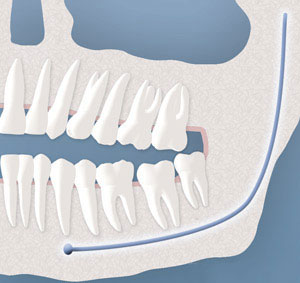
- Soft Tissue Impaction: The upper portion of the tooth has erupted through the bone but not all the way through the soft (gum) tissue.
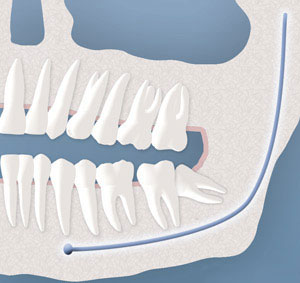
- Partial Bony Impaction: The tooth is still mostly located within the jawbone, although a small portion has pushed through.
- Full Bony Impaction: The entire tooth still lies within the jawbone.
 Soft Tissue
 Partial Bony
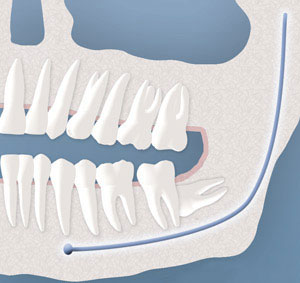 Complete Bony
We want you to know that if you have been told you have an impacted wisdom tooth (or two), you’re not alone! This common condition is one that we treat regularly in our office. As oral surgeons, we are specially trained to handle even the most complex cases of impacted teeth in our office. Please call us with any questions you may have about your wisdom teeth management.
Frequently Asked Questions
Impacted wisdom teeth do not always cause symptoms right away. When problems develop, you may notice pain or pressure toward the back of the jaw, swelling, tenderness, difficulty chewing, or signs of infection around a partially erupted tooth. Impacted teeth can also affect nearby teeth even when symptoms are limited. If an impacted wisdom tooth is causing problems, Dr. Biggerstaff, Dr. Parker, or Dr. McElroy can determine whether wisdom teeth removal should be considered. AOFSTriad notes that impaction can contribute to infection and damage to nearby teeth.
Your oral surgeon will examine the area and review dental imaging to determine the position of the wisdom teeth, the depth and type of impaction, and their relationship to nearby teeth and surrounding anatomy. When more detailed visualization is needed, AOFSTriad can use 3D imaging as part of treatment planning. Evaluations are available at the practice’s Kernersville and Bermuda Run/Advance offices.
Not necessarily. Dr. Biggerstaff, Dr. Parker, or Dr. McElroy will consider the tooth’s position, level of impaction, symptoms, and whether it is affecting nearby teeth or tissues before recommending treatment. When an impacted wisdom tooth is causing problems or poses a risk to surrounding structures, wisdom teeth removal may be recommended. AOFSTriad also notes that some wisdom teeth can be monitored when they are not creating problems.
Impacted wisdom teeth can vary based on both their angle and how deeply they are covered by gum tissue or bone. A tooth may be angled forward, backward, sideways, or remain more upright while still being unable to fully erupt. Impactions may also be classified as soft-tissue, partially bony, or fully bony depending on how much of the tooth remains covered. Your oral surgeon can identify the type of impaction from your examination and imaging and explain how it may affect treatment.
Recovery varies depending on factors such as the depth of the impaction, the number of teeth removed, and the complexity of the procedure. Many patients can begin returning to normal activities within a few days, although swelling commonly peaks around 48 to 72 hours after surgery before beginning to improve. Your surgical team will provide instructions based on your procedure, and you can learn more about what to expect on the wisdom teeth removal page.